Stuart Harrison
RMIT Architecture & Design Theory Seminar
with Peter Raisbeck: Neoclassicism and Modernity
ESSAY
The Men Without Qualities.
Neutra/Loos/Musil/Wittgenstein
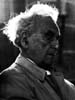
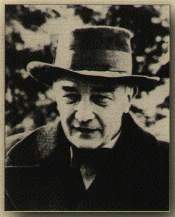
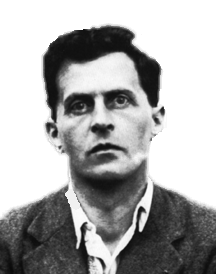
Richard Neutra was born in Vienna in 1892. It is around this time in Vienna that all the figures I wish to refer in this essay were born. Ludwig Wittgenstein in 1889, Robert Musil in 1880 and Adolf Loos in 1870. It shall be the scope of this essay to examine the role of these men in relation to the culture that found themselves a part of, and to see if any of this attitude was translated to America – via Neutra – the only one of them to make it to the New World. The Lovell-Health House will be used as a case study, as it was Neutra’s first major commission in his adopted home of California.
Robert Musil’s monumental literary work, The Man Without Qualities, forms a backdrop to life in Vienna, and the book, enjoying a renaissance at this time, is considered as being a comprehensive document of the period. In Frederik Tygstrup’s essay, The Monstrous Novel, The Man Without Qualities is compared to other massive ‘unreadable’ works, being Marcel Proust's Remembrance of Things Past and James Joyce's Ulysses. He also discusses the phenomena of the generation:
In a number of diary-entries from the mid-twenties, Robert Musil meditates on the unique situation of his generation - those born around 1880. They have grown up within the bourgeois culture of the nineteenth century; their personalities, world-views, and conceptions of reality belong to a "world of yesterday", as Stefan Zweig put it, while on the other hand they find themselves, as they reach their mature age, not only in an other period, but in a completely different world.
The relevance of the novel and the nature of the time is also discussed in the essay Modernity Laid Bare, by Virgil Newmoianu:
At the end of the 20th century, we live out, on a planetary scale, what was happening to the people of a limited, and marginal, part of Europe a good hundred years ago. Those people, with all their failings, managed to come up with some truly brilliant ideas to respond, in a very creative way, to their predicaments. The double-monarchy finally went under, but for the reader and observer of a century later, its story is one of achievement and of repeated triumphs. It tells us how a framework could be built in which the waltzes of Strauss could coexist with the most radical avant-garde of the time. It is the story of a world in which crown and altar lived together with capitalist enterprise and radical socialism. It is the story of a world in which social injustice and ethnic friction existed but never reached, nor even approached, the terrors of only a few decades later. What was this world like? Few portray it with more elegance and perception than Robert Musil in his The Man Without Qualities. A truly attentive reader will learn much about Central Europe from its luminous pages, but even more about the destiny of our own late 20th-century societies
Musil was, like Loos and Wittgenstein, was somewhat of an anglophile, even dropping his full title, Robert Elder von Musil. His book, which is essentially his life’s work, makes several "urban" references, for example;
Modern man is born in hospital and dies in hospital – hence he should also live in a place like a hospital. – This maxim had just been formulated by a leading architect, and another one, a reformer of interior decoration, demanded movable partition-walls in flats, on the grounds that in living together man must learn to trust man and not shut himself off in spirit of separation.
Adolf Loos’s modernity is accepted to have sought a break from the tyranny of Austria’s romanticism, typified by England and America. This feeling is shared,
Following Musil's reflection, we get the impression of a generation striving to break its own way out of the nineteenth century and into the twentieth with a new enthusiasm born out of the extremely fertile movement of ideas in the european fin-de-siècle.
Richard Neutra had been a student of Loos in the few years prior to the outbreak of the First World War, when he was only 20. Loos had moved to Vienna in 1896 and had become an influential figure, attracting students such as Neutra, through "the quality of Loos’s architecture, the bravado of his frequently outrageous iconoclasm, and his obvious personal charisma"
The extent of the influence of Loos on the younger Neutra can said to not only of influenced the language of his eventual architecture, but on his decision to go to America, which Loos had visited and worked in the few years prior to settling in Vienna.
The thing about Loos that "stayed with me the most," Neutra concluded, "was his faith in and almost cult of ‘lastingness,’ as compared with passing fashion. He was reaching out for some contact with history despite the fashions of the day."
A more immediate legacy for Neutra was Loos’s passion for the people, the culture, and the architecture of America. It was largely Loos’s faith in the promise of American life that ultimately propelled Neutra to the United States.
Loos disparity in Austrian life is a common feeling amongst the figures mentioned here. Although regarding now as very ‘cultural’ time, it was believed that culture had been compromised seriously in Vienna and the rest of Europe.
Adolf Loos’ severity still has an illuminst background; as his worldliness, his interest in things and fashion and the cynicism with which he balances his desire for the absolute, is illuminist. It is also, in the Viennese, or European culture, very easy to draw a parallel with Musil/Ulrich where ‘for him ethics were… the infinite complexity of the possibilities of life… He believed in a power of growth in ethics, in step with his experience and not just as it is commonly understood, in step with his knowledge, and that they were therefore something stable for which man alone is not pure enough… Ethics are fantasy… the consequence of which is this: an ascending path of intelligence and its creations that rises in amore or less straight line, despite doubts, through the changes of history’
To what extent was this understanding imparted onto Neutra? It can be said that Neutra adapted an ethical viewpoint as his attitude of modernity, his attempts to research construction techniques in America, the home of Modernity and Frank Lloyd Wright. The attitude was somewhat utopian, going to America to find a purism or truth.
Like many other Viennese of his day, Loos came to understand at an early stage his own need for a new and comprehensive relationship with society: this was not to be a a dictatorship of the artist over his public, but an essentially reciprocal relationship between the two. As in Hugo von Hofmannsthals’ play Der Tor unde der Tod (‘Death and the Fool’) of 1893, the aesthetic man is revealed as the man who ultimately feels nothing at all. Loos’s marked preference for the English aesthetic and the American Transcendental movements espoused by John Ruskin, Walter Pater and Ralph Waldo Emerson against others - in marked contrast – to the aesthetic of Henry van der Velde and his followers – arose from their habit of combining moral passion and social consciousness with the pursuit of truth.
To what extent can Loos’s understanding be related to other figures. Aldo Rossi states, about Loos;
There can no doubt that he belonged to Viennese culture; a culture with many interests and many possibilities. The link with Karl Kraus is sure, and with his best friend Peter Altenberg too, as is evident in the analogy with the writers or artists we have spoken of before: Robert Musil, George Trakl, Egon Schiele. But what counts in criticism, or in critical understanding, are the differences and peculiarities. We can surely apply many of the maxims and aphorism of his contemporaries to Adolf Loos and vice versa; but this is almost a game.
So Wittgenstein’s ‘thought’, ‘what is torn, torn must remain’, could represent Adolf Loos’ detachment from architecture but is also represents nothing.
The importance of cross-comparison is what Rossi maintains is in the differences and it is with that attitude I intent to look and the Lovell-Health House, which Neutra was commissioned to design in 1927.
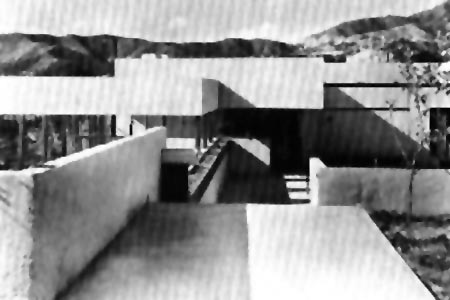
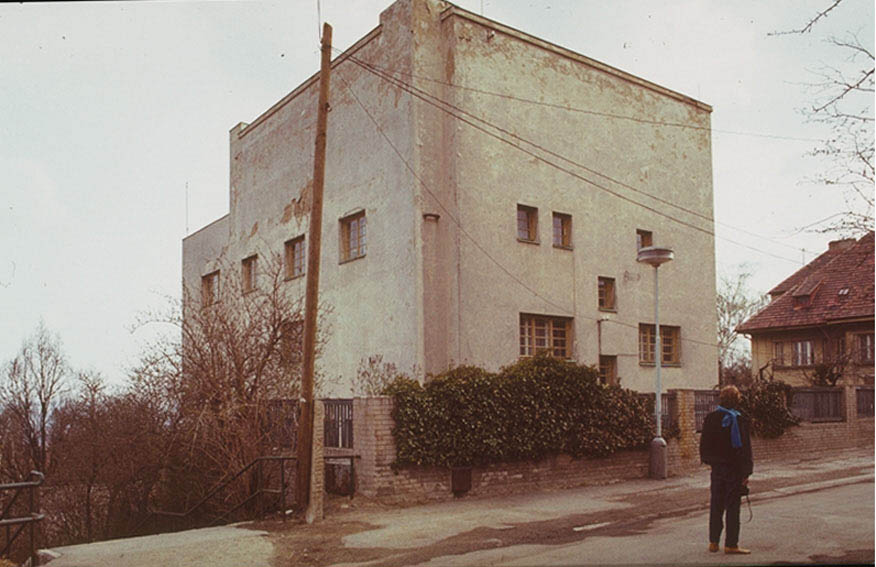 Neutra’s career-making commission was somewhat of a turn around for the clients, Philip and Leah Lovell, who had traditionally given their jobs to R.M. Shlinder, who Neutra lived and practiced with. It is clear that the house is influenced by Loos is its language. It is perhaps most useful to compare with what are superficially the most similar houses, being the Moller and Muller houses, designed at approximately the same time as the Lovell Health House. For the purposes of comparison to the Wittgenstein’s precise Wittgenstein-Stonborough House the Muller house is of interest.
Both Neutra and Loos were craftsmen, who took into their own hands an implicit understanding of how their buildings were assembled. Whilst Loos is known for his passion for stone and his knowledge of the craft of masonry, this translates for Neutra into an obsession with construction systems, and was the first to build a system house with the Lovell Health. The design evolution is described Thomas S. Hines’ book, Richard Neutra and the Search for Modern Architecture. Of interest here is the following,
Discarded preliminary sketches featured larger and simpler expanses of massing than the complex assemblage of elements in the final design. As such, the early studies predicted Neutra’s basic house designs of the thirties.
It is argued by Yehunda Safran that Loos’s Raumplan was a manifestation of the wider cultural concerns that ran through many Viennese cultural figures, what Safran cites from Schoenberg as "search for a spatial structure", which "achieved the intensity that Loos, Kraus, Kokoschka, Schoenbreg and Wittgenstein felt had been stifled by outworn conventions. They charged their compositions with expanded forms which generated simultaneously various dimension within space."
Safran continues and extends this to Loos specifically,
Loos’s abiding conception of the Raumplan, a ‘spatial plan’ creating interlocking spaces across levels, functioned as a profound departure from the standard floor-by-floor design. This saturation of architectural inhabited space was his substitute for rooms blocked out arbitrarily, with their purposes assigned to them indifferently. It achieved an intricate, whole spaced formed of discrete yet interrelated shapes, traversing the distance between the public and the private, between the open and the more intimate and secret, between the immediately accessible and the gradually revealed, and between that which offers eye-contact, with no obvious physical connection, and that which appears to be visually accessible, but remains forever inaccessible, like the mirrors placed above eye level in the Karntner Bar.
It is possible to see that Neutra’s first house does this; manifests the interlocking complex of the Raumplan, but not as much as internally, but as the exterior treatment, the Loosian interior turned inside out but rendered in the same way. The convincing way that this house relates to undulating site can be seen as treating it in the manner of an interior space, such is it remarkable involvement in the scheme. The is best seen in the 1929 model of the house, and is somewhat reliant of the landscape walls to be visible, which there no longer are as they are covered in foliage.
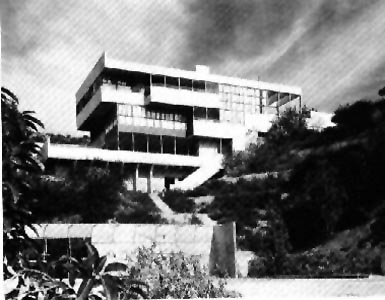
The effect of seeing the house from the bottom of the site, as so the viewer is looking up at the house, is two amplify the perspective judgement of the house’s lines. No horizontal is below the horizon line although the composition itself is horizontal. This appreciation of the sites levels demonstrates a key understanding on the image of project by Neutra (which was very widely published), despite the fact this is not the view given as the building is approached – the entry is on the top floor (of two and half levels).
Neutra’s involvement with the house and its construction was very extensive, deciding to act as the general contractor of the building himself, as he could not find a builder competent and motivated enough to take the challenging task on. This is reminiscent of Wittgenstein’s involvement with the house for his sister, the history of which is littered with accounts of Wittgenstein’s precise obsession with every detail and dimension. The attitude of precision can be seen as another common thread between these figures. Wittgenstein’s perfection extended into his philosophical work, and lived a tortured life because of it, "It’s as if I’m being burnt by a freezing wind". This is excellently portrayed in Derek Jarman’s film Wittgenstein that also deals extensively with the philosopher’s association with Berthrand Russell and John Maynard Keynes.
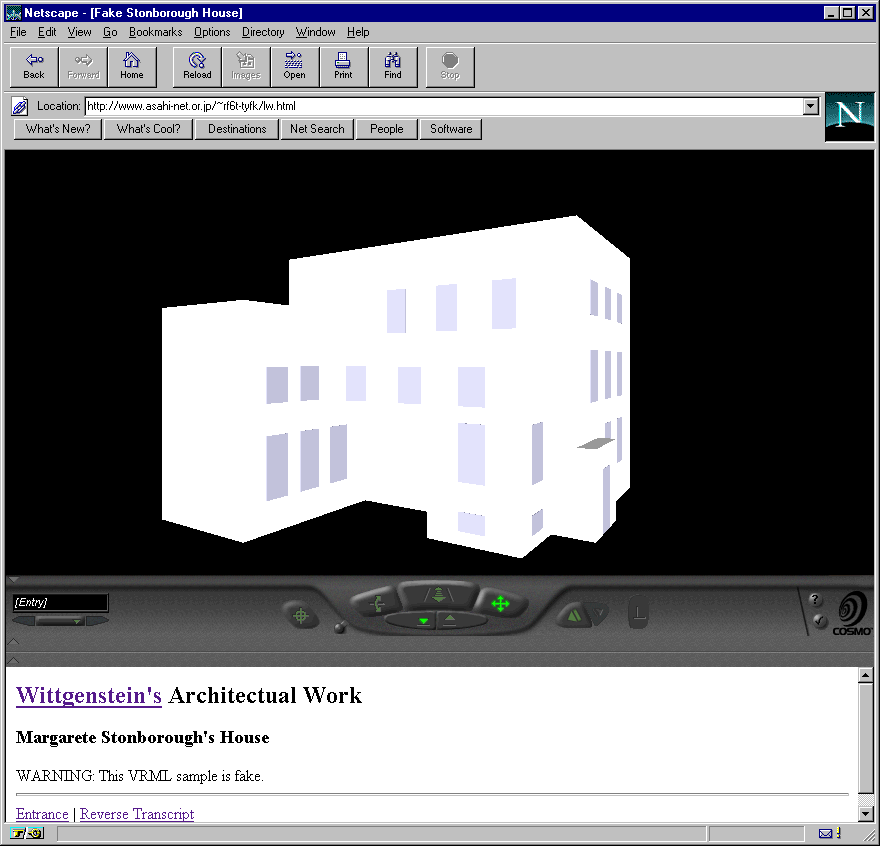
Wittgenstein’s house for his sister came to the philosopher when experiencing a very depressed period in this life, and was to a large extent an act of charity by his sister to give him something productive to occupy his mind. Sketches for the house had been done by Paul Engelman, who was then to work with Wittgenstein on the house, but the obsessive philosopher took over design roles completely. Wittgenstein’ principal operation on Engelman’s house was to remove from its exterior decoration and to refine the location of size of the openings. The basic planning was maintained, but the refinements introduced a precise proportional system.
Possible the most interesting space in Neutra’s plan of the Lovell-Health House was the main living room, which ran down the entire length of the south face, at about half the width of the house.
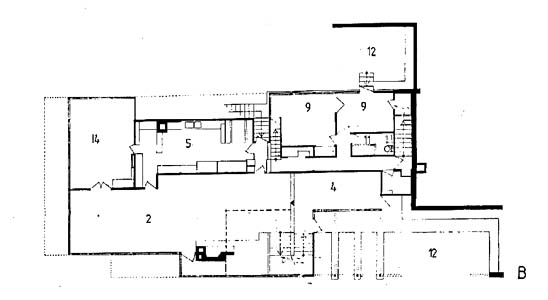
This open plan libre type space contrasts with the other half of the rooms on that level, broken down into smaller rooms (more raumplan) such as the kitchen and service areas. This treatment on the mid-level was repeated for the majority of the upper (entry) level but which featured another open space, this time the outside patio adjacent to the entry. The plan of the lower level is perhaps the most engaging as it contains the Neutra trademark of the swimming pool, a symbol of Californian life. The pool starts enclosed, the mid level suspended above on the fine steel columns (the house was supported by a steel frame, erected in 40 hours, designed in a year). The pool (room) then extend out further over the descending site, reflecting the house in this mirror. It could be argued that this Loosian reflection again points to an inversion of Loos’s language.
Loos implanted more than a spirit of revolt in Schindler and Neutra. They both would be influenced by his work and his teachings. Loos’s stated intention of catering in his buildings to "modern nerves" was to enter Neutra’s philosophical approach to design.
It can be said that Neutra’s relation to Loos in more than a stylistic one, and that of more importance is an attitude that came out of the condition in Vienna, and what Frampton had termed "The Crisis of Culture", of which Musil and Wittgenstein were clearly a part. These are more complex versions of Modernity and culture than is associated with the totalising conceptions of other, slightly later ‘Modern Masters’, although Neutra conformed with Modern dogmas – he developed a belief in the Utopian ideal, he like Le Corbusier designed the utopian city – his was Rush City.